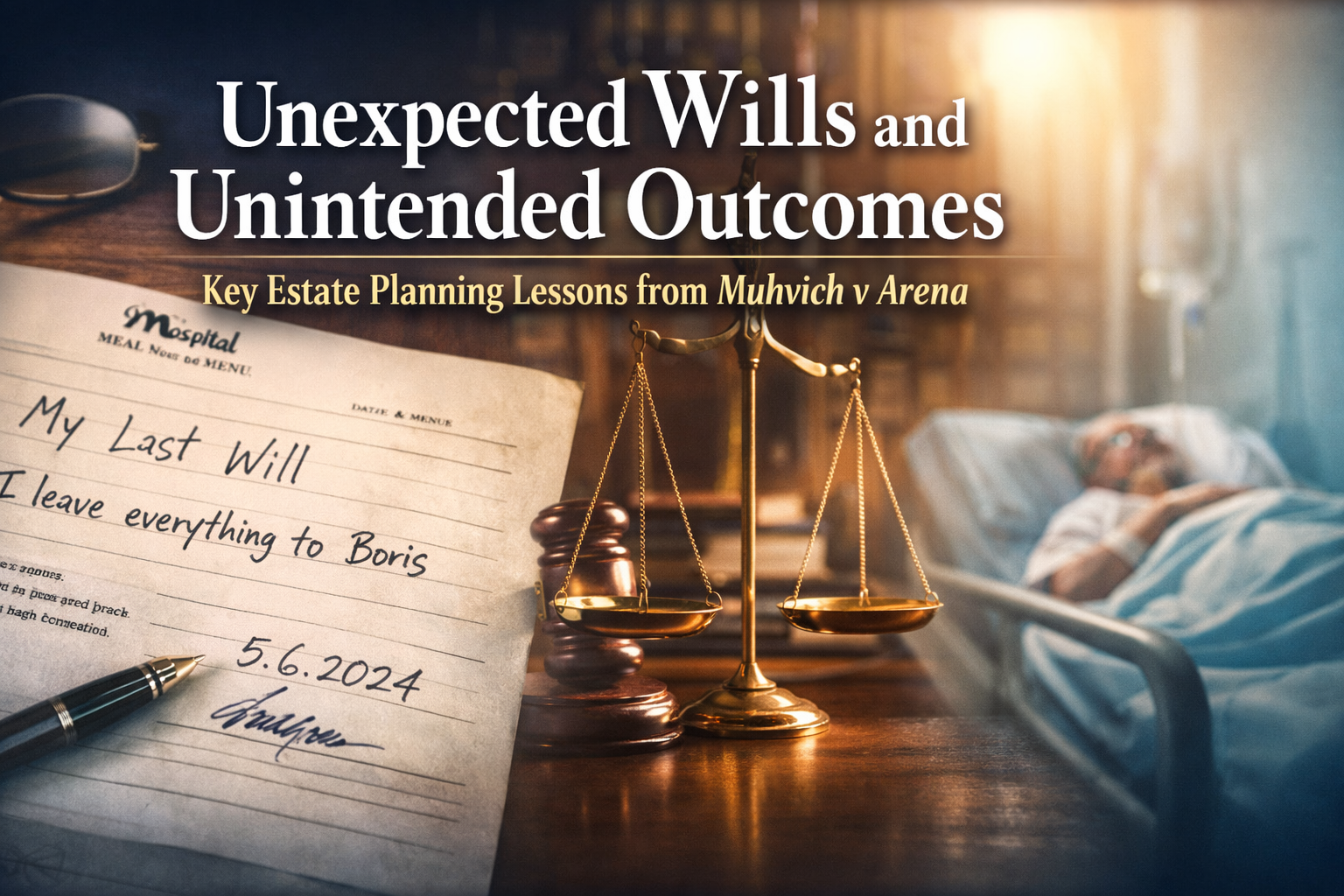
What happens when a dying man scribbles his final wishes on a hospital menu form — and a court is asked to treat it as his last will?
The recent New South Wales Supreme Court decision in Muhvich v Arena [2026] NSWSC 333 answers that question. From Hill Legal’s perspective, the case provides powerful and practical lessons for anyone involved in estate planning.
The Facts
Colin Jameson, a 71-year-old motor mechanic, passed away on 10 September 2024 after battling brain cancer. He had been in a long-term de facto relationship with Tammy Arena from 1987 until their separation in 2020.
Tammy’s daughter, Sarah, was just two and a half years old when Jameson entered her life. Although he never formally adopted her, he raised her as his own for more than 16 years. Their relationship was deeply parental in nature.
Jameson’s only formal will, made in 2007, left his estate to Tammy, with Sarah as a default beneficiary. He had no biological children.
In June 2024, while gravely ill in hospital, Jameson took matters into his own hands. He prepared two handwritten documents on hospital menu forms stating that he wished to leave all of his possessions to his lifelong friend, Boris Muhvich. He signed and dated both documents.
Although he later contacted a solicitor to formalise a new will, he refused to proceed after being quoted a $770 fee. Importantly, he kept the handwritten documents, referred to them as his “new will,” and ensured they were passed on before his death.
Jameson died leaving an estate valued at approximately $500,000.
The Court’s Decision
The Court considered three key issues.
1. Was the handwritten document a valid will?
Yes.
Applying section 8 of the Succession Act 2006 (NSW), the Court found that the documents:
- Were in writing and signed
- Clearly expressed testamentary intentions
- Were intended to operate as a final will “without more”
The Court accepted that Jameson’s conduct — including preparing the documents, seeking details, retaining them, and referring to them as his will — demonstrated clear intention.
His earlier formal will from 2007 was found to be revoked by implication.
2. Could Sarah bring a family provision claim out of time?
Yes.
Although her claim was filed 10 weeks late, the Court allowed an extension due to:
- The relatively short delay
- Her personal circumstances
- Lack of prejudice to the estate
- The merit of her claim
3. Was Sarah entitled to provision from the estate?
Yes.
The Court found Sarah to be an “eligible person” due to her upbringing and partial dependency on Jameson.
Key factors included:
- A relationship equivalent to parent and child
- Long-term emotional and financial support
- Sarah’s significant financial hardship
Despite the handwritten will leaving everything to Muhvich, the Court awarded Sarah $200,000 — approximately 40% of the estate.
All parties’ legal costs were also paid from the estate.
Hill Legal’s Key Estate Planning Insights
From Hill Legal’s perspective, this case highlights several critical issues:
1. Informal documents can become legally binding
Even something as simple as a handwritten note on a hospital menu can be treated as a valid will if the intention is clear.
2. Delaying formalisation can create risk
A relatively modest legal fee led to a situation where informal documents governed a significant estate — with unintended consequences.
3. Family provision claims remain powerful
Testamentary freedom is not absolute. Courts will intervene where there is a moral obligation, particularly in stepfamily situations.
4. Stepchildren and blended families must be considered carefully
Relationships formed over time — even without formal adoption — can carry significant legal weight.
5. Outdated wills can lead to disputes
Jameson’s 2007 will no longer reflected his circumstances following his separation, contributing directly to the dispute.
6. Modest estates are not immune
Even estates of relatively moderate value can be subject to costly litigation, significantly reducing what beneficiaries ultimately receive.
7. Accessibility in estate planning is critical
Clients facing illness or time constraints need practical, flexible options to ensure their intentions are properly documented.
Hill Legal’s Hot Take
Muhvich v Arena is a powerful reminder that estate planning is not just about documents — it is about relationships, timing, and clarity of intention.
A handwritten note may carry legal weight, but it cannot always protect against competing moral claims or prevent costly disputes.
At Hill Legal, we help clients ensure their estate plans are clear, legally sound, and reflective of their true intentions — while also minimising the risk of future challenges.
Need Help With Your Estate Plan?
If you have questions about your will, blended family arrangements, or protecting your estate from disputes, the team at Hill Legal is here to help.
Contact Hill Legal today on 03 5976 6500 to ensure your estate planning is properly structured, up to date, and aligned with your wishes.